
Best Country in Southeast Asia for US Investment: A Framework, Not a Single Answer
The short answer
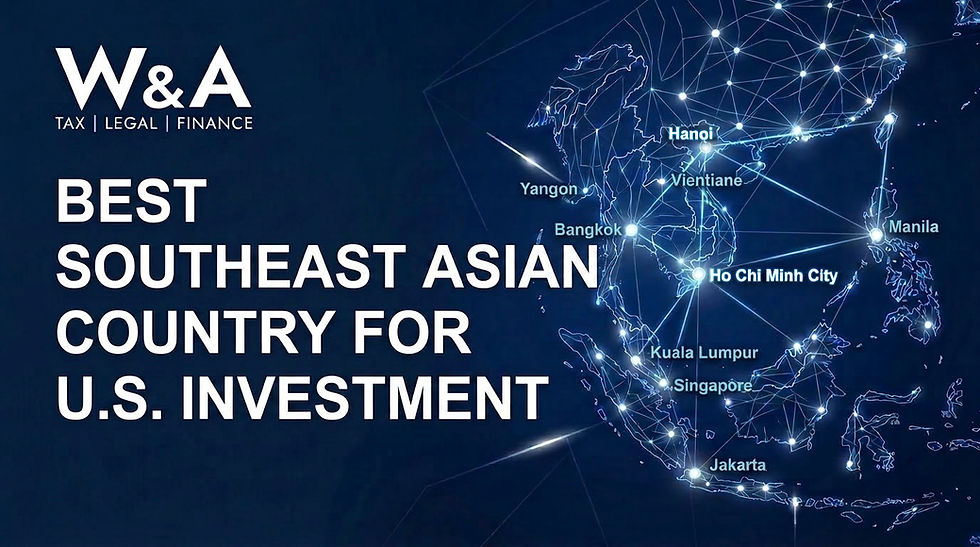
There is no single best country in Southeast Asia for US investment — the right jurisdiction depends on what the investment is for. As a rough framework: Singapore for a regional holding company and treaty-efficient structuring; Vietnam for manufacturing, export capacity, and supply-chain diversification; Indonesia for large-scale domestic consumer market access; and Thailand for automotive, agribusiness, and established regional supply chains. Many sophisticated US groups don’t pick one — they use a Singapore holding structure above operating entities in two or three of the others.
Why this decision shouldn’t start with tax rates
Headline corporate tax rates across the region cluster fairly closely — Singapore at 17%, Thailand and Vietnam at 20%, Indonesia at 22%, Malaysia at 24% — meaning the tax rate rarely decides the comparison on its own. The more consequential differences are: whether the US has a tax treaty with the country (Thailand and Indonesia have long-standing US income tax treaties; neither Vietnam nor Singapore has one in force — see our article on the US-Vietnam Tax Treaty: Why There Is (Still) No Treaty in Force — and What US Businesses and Individuals Should Do Instead, how each country’s transfer pricing and withholding rules interact with US reporting obligations, and how straightforward the licensing process is for the specific industry involved.
A practical framework by investment type
Manufacturing / supply-chain diversification → Vietnam is frequently the strongest fit, supported by consistently high FDI implementation levels, streamlined 2026 investment licensing reforms, and strong existing manufacturing FDI momentum from Korea, Singapore, China, and Japan-based investors — though US investors need to plan around the absence of a tax treaty from day one, not discover it later.
Regional holding / IP or treasury center → Singapore remains the default choice for most US groups structuring a regional headquarters, given its extensive DTA network, no withholding tax on dividends to non-residents, and 17% corporate rate.
Large domestic consumer market access → Indonesia’s scale (a population exceeding 270 million) makes it the strongest single-country consumer opportunity in the region, at the cost of a somewhat more layered licensing process for larger or regulated projects.
Automotive, agribusiness, established supply chains → Thailand’s decades of automotive and agribusiness FDI infrastructure, plus Board of Investment incentives offering exemptions of up to 13 years for promoted sectors, make it a strong fit for those specific industries.
The US-specific wrinkle that changes the calculus for Vietnam and Singapore
For Thailand and Indonesia, a US-headquartered group can rely on an in-force tax treaty to reduce withholding rates and access a Mutual Agreement Procedure if a transfer pricing dispute arises. Vietnam and Singapore are both exceptions — Vietnam’s 2015 treaty was never ratified by the US Senate, and the US and Singapore have never concluded a comprehensive income tax treaty at all (only a narrow shipping and aircraft income agreement exists). This doesn’t make either the wrong choice for US investors — Vietnam’s manufacturing and supply-chain fundamentals remain strong, and Singapore remains the standard regional holding jurisdiction for other reasons — but in both cases the tax and transfer pricing structuring needs to be built more carefully from the outset, without the safety net a treaty would otherwise provide.
How W&A Consulting helps
We advise US companies specifically on how the absence of a US-Vietnam treaty changes practical structuring decisions — from entity choice to intercompany financing to transfer pricing documentation — so Vietnam’s genuine strategic advantages aren’t offset by avoidable tax cost. Our Managing Partner’s KPMG Tax and Legal Director background includes direct experience advising multinational entrants across the region.
Comparing Vietnam against other ASEAN markets for a US investment thesis? Contact W&A Consulting for a structuring-first comparison.
FAQ
Which ASEAN country has a tax treaty with the US?
Thailand, Indonesia, and the Philippines, among others. Vietnam has a signed but unratified 2015 treaty, and Singapore has no comprehensive income tax treaty with the US at all.
Is Vietnam still a good destination for US investment without a tax treaty?
Yes for the right strategy (manufacturing, supply chain, export) — but the absence of a treaty needs to be actively planned around rather than assumed away.
Should a US group pick one Southeast Asian country or structure across several?
Many US groups use a Singapore holding entity above operating subsidiaries in Vietnam, Indonesia, or Thailand, depending on the specific business need in each market.
Comments